Research
Research Interests
My main research interests include:
- Unsupervised Learning
- Deep Clustering
- High-Dimensional Data Analysis
- Representation Learning
- Computer Vision
- Self-Supervised and Contrastive Learning
- Explainable Artificial Intelligence
- Graph Neural Networks
- Topological Data Analysis
- Human-in-the-Loop AI
- Intelligent Decision-Support Systems
Research Methodology
My research follows a data-driven and interdisciplinary methodology, combining representation learning, clustering, statistical validation, and domain expertise.
The general workflow I use for developing new deep clustering methods starts with the collection, governance, processing, and curation of multimodal data, followed by representation learning to extract compact and informative features/embeddings. Clustering methods are then applied to discover meaningful structures, which are evaluated through quantitative metrics and statistical analysis. Finally, the resulting clusters are interpreted with domain experts, with Large Language Models potentially supporting interactive analysis and knowledge validation.
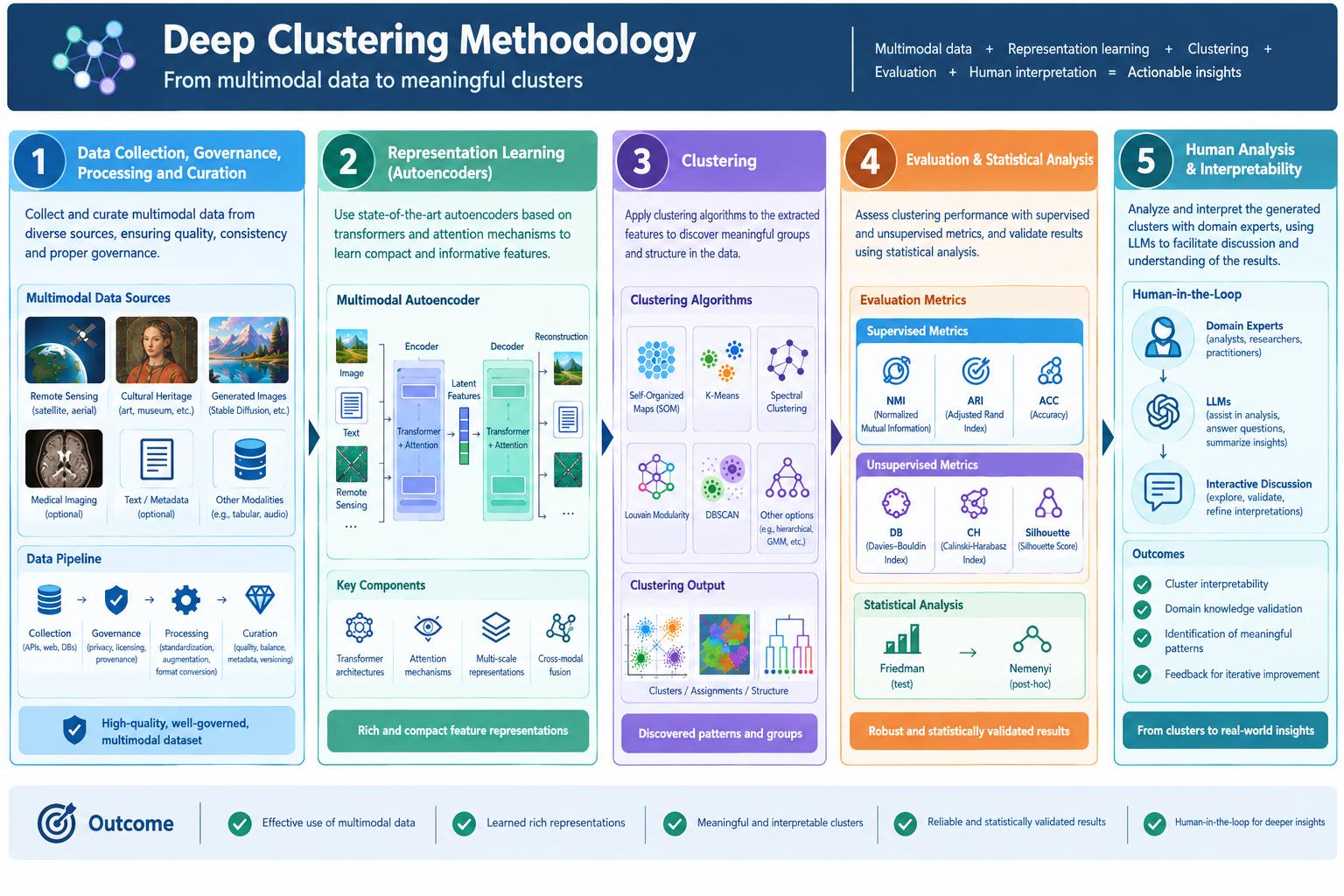
This methodology is designed to move beyond purely numerical clustering evaluation by connecting learned representations and discovered structures with domain knowledge and human interpretation. The ultimate goal is to develop clustering methods that produce not only statistically meaningful groups, but also interpretable and actionable insights.
Open Science
I value reproducible and accessible research. My work includes open-source implementations, research repositories, technical reports, preprints, and contributions to the broader research community.
I also participate in peer review and research mentoring, with a particular interest in helping bridge machine learning research, software engineering, and real-world applications.
Research Philosophy
I believe that impactful AI research requires more than powerful models. It requires solid data, meaningful representations, rigorous evaluation, and human-centered interpretation.
My goal is to develop AI methods that can transform complex and high-dimensional data into reliable, interpretable, and useful knowledge.